Gay Tourism - Buenos Aires, Argentina
|
 |
In 2004 Buenos Aires became
the first city in Latin America to legalize civil unions, and in 2010 same
sex marriages. A steady
sexual liberalization has allowed not only locals but also gay visitors to
enjoy all the city has to offer without fear.
Buenoss Aires is divided
into 48 barrios (neighborhoods), several of which gather the gay-friendly
hotels, restaurants, bars, and clubs into a few square blocks. Not
surprisingly, they are also barrios where the historical sites and cultural
offerings are clustered. |
You will find
yourself right at home in posh Recoleta, trendy Palermo, tango-inspired
San Telmo, and the bubbling Microcentro (downtown). Other barrios such
as Belgrano, Nuñez, Barrio Norte, and even the traditional Colegiales
are also of interest and increasingly gay-infused.
|
 |
All of these barrios feature many strutting straight guys sporting
skin-tight pink T-shirts, designer jeans and trendy haircuts. Don't be
confused: Native Argentines maintain a complicated relationship
between outward appearance and inner machismo, a balance they claim
women enjoy. Whatever! If there is one place that embodies the
cultural tensions between European and Latin American societies, it's
Buenos Aires, so just savor the contradictions.
"If you want to
walk with your partner holding hands, no one will say anything," Melia said.
For
the past few years, Buenos Aires has reigned as Latin America's preeminent
gay travel capital. Gays and lesbians are estimated as being as high as 15%
to 20% among international tourists, and many mainstream places stress their
gay-friendliness. One reason for the boom is simply economics, but there has
also been an effort by the city to make sure that gay tourism is officially
recognized. |
With
its enormous collection of bars, dance clubs, restaurants, and tango halls
catering to the community, no other city in Latin America rivals what Buenos
Aires has to offer for visiting gays and lesbians.
For
the past few years, Buenos Aires has reigned as Latin America's preeminent
gay travel capital. Gays and lesbians are estimated as being as high as 15%
to 20% among international tourists, and many mainstream places stress their
gay-friendliness. One reason for the boom is simply economics, but there has
also been an effort by the city to make sure that gay tourism is officially
recognized. With
its enormous collection of bars, dance clubs, restaurants, and tango halls
catering to the community, no other city in Latin America rivals what Buenos
Aires has to offer for visiting gays and lesbians.

There are also
gay-only bed and breakfasts, gay-run restaurants, a nearby gay-only beach,
and shops and hotels that advertise as "gay-friendly". Though there is no exact information on the
number of gays and lesbians living in Buenos Aires, the community is one of
the most open and vibrant in the region. The Argentina Homosexual Community,
the country's first gay rights organization, was created in 1984.
The city's incredible
shopping may make this the favorite part of your stay. From centuries-old
antiques to South America's best fashions, Buenos Aires is likely to
bring out the shopper in anyone.
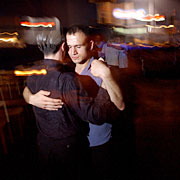
Gay Tango:
When he's in
town, he teaches tango at Lugar Gay, a guesthouse exclusively for men
in the neighborhood of San Telmo.
"One night I was dancing
with a man," he says. "Then the next time another couple of gay men joined
us. And so on. Now we have gay lessons and a gay milonga."
Indicative of major
changes in Argentine society, the gay tango is something of a perfect
storm that came about from an economic crisis, improved civil rights
for homosexuals and a revival in tango's popularity.
Nightlife:
Edgy,
avant-garde, and fashionable are just some of the words that can be used to
describe the bars and clubs in Buenos Aires. This city truly has a fabulous
gay scene with its ecstatically amazing gay bars and clubs. These gay venues
usually provide brilliant bars and fantastic deejays playing cool tunes. The
atmosphere in the gay bars and clubs here can be both vibrant and euphoric.
Everyone will be surely guaranteed of brilliant time. Basically, the venues
here are somewhat a la 'Sex and the City'. Although, one need to remember
that the clubs here doesn't really start until 2 a.m. It is advisable to
sleep during the day if you plan to have fun the Buenos Aires way. Just get
ready to party like the locals.
Lodging:
Buenos
Aires offers a wide range of gay and lesbian guesthouses plus bed and
breakfasts as well as the straight-friendly
Axel hotel. Most other hotels
are gay-friendly in Buenos Aires. Hotels range from small boutique hotels to
5 star deluxe hotels. A very common and inexpensive home-away-from-home is a
vacation apartment rental. Several gay-owned and operated agencies
specialize in these suite rentals to the gay and lesbian traveler. Buenos
Aires also has an abundance of inexpensive gay and lesbian hostels, inns,
and accommodations for younger gay and lesbian travelers or those traveling
on a limited budget.
 |
|